
We were delighted to have yet another Sip with the Expert session with Dhyey Solanki where he presented on the stratospheric ozone layer. His presentation covered the scientific discovery of ozone depletion, political response to it, and the ongoing monitoring of the ozone layer and substances controlled under the Montreal Protocol.
Key aspect of the presentation
The Science of Ozone:
Ozone (O3) is a highly reactive gas composed of three oxygen atoms and is primarily found in two layers of the atmosphere. The ozone layer in the stratosphere, the second layer of the earth’s atmosphere extending from 10-15 km above the Earth’s surface to around 50 km acts as an umbrella protecting the planet by absorbing harmful UVB and UVC radiation. While the first layer of the atmosphere from the surface – the troposphere – can also contain ozone, the vast majority of atmospheric ozone is found in the stratosphere. In the troposphere, however, ozone is characterized as a harmful pollutant and is regulated. When we talk about ozone in context of the Vienna Convention (1985) and the Montreal Protocol (1987) we are talking about the stratospheric “good” ozone.
Key milestones:
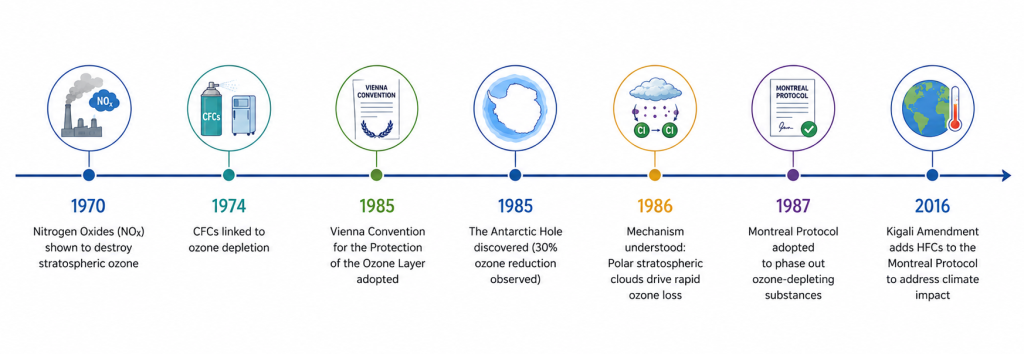
- Nitrogen Oxides (NOx) causing destruction of stratospheric ozone: In 1970, scientist Paul Crutzen demonstrated that a single NO molecule can repeatedly break down ozone (O₃) into regular oxygen (O₂) without being consumed itself, proving that ground-level human activities directly impact the upper atmosphere.
- Chlorofluorocarbons (CFCs) causing destruction of stratospheric ozone: Scientists Mario Molina and Sherwood Rowland demonstrated how chlorofluorocarbons depleted Earth’s protective ozone layer in 1974. CFCs were widely used as refrigerants in refrigerators and air conditioners, as well as aerosol spray propellants and foam-blowing agents.
- Vienna Convention for the Protection of the Ozone Layer: Owing to research by Mario Molina and Sherwood Rowland on the potential of CFCs causing ozone depletion, a framework for dialogue between scientists and diplomats was established in the form of the Vienna Convention.
- The Antarctic Hole: British scientists Joe Farman, Brian Gardiner, and Jonathan Shanklin discovered a 30% reduction in ozone over Antarctica during the springtime, publishing their paper in May 1985. Susan Solomon later solved the missing puzzle by explaining how polar stratospheric clouds provide a surface for chlorine to react catalytically, destroying ozone much faster and at higher rates than previously predicted in 1986.
- The Montreal Protocol: A legally binding treaty that set specific targets to phase out CFCs and other ozone-depleting substances (ODS) was established through Montreal Protocol in 1987.
- The Kigali Amendment: This amendment in 2016 expanded the Montreal Protocol to include hydrofluorocarbons (HFCs). While HFCs do not deplete ozone, they are potent greenhouse gases that are used as a transition away from CFCs.
Current Challenges and Monitoring:
The ozone layer is showing signs of improvement, but a full recovery to pre-1980 level is projected to occur by about 2040 globally. Recovery is expected to take longer over the poles, with Antarctic ozone projected to return to pre-1980 levels around 2066. Ongoing challenges include:
- Unexpected Emissions: In 2018, unexpected increases in CFC-11 beginning in 2011 were detected, eventually traced back to production in China, illustrating the need for constant monitoring.
- Limited control over production of other ozone-depleting substances: Nitrous Oxide also known as laughing gas, often emitted to the atmosphere from use of fertilizers and from wastewater treatment, is currently the most significant ozone-depleting substance that is not yet a controlled substance under the Montreal Protocol.
- Monitoring Gaps: Global monitoring of ODS relies on networks like AGAGE and NOAA, using ground stations. However, there are massive gaps in monitoring especially in the Global South with only one monitoring station in Rwanda.
While the depletion of ozone hole is largely controlled, continuous global action and expanded monitoring are still required.
The QnA we delved into:
Chemically, they are both O3. However, “bad” ozone is found at the ground level (troposphere) where it is a regulated pollutant harmful to health and plants. “Good” ozone is in the stratosphere, where it protects life from UVB and UVC radiation.
The “hole” is specific to Antarctica due to a unique combination of meteorological and chemical conditions. The extremely cold Antarctic stratosphere allows polar stratospheric clouds to form, while the strong and persistent polar vortex isolates the air over Antarctica, limiting the transport of ozone supply from the tropics during the winter. When sunlight returns in spring, chemical reactions involving chlorine and bromine rapidly destroy ozone.
Ozone depletion also occurs elsewhere, including in the Arctic and at mid-latitudes, but it is generally much less severe. The Arctic stratosphere is warmer and its polar vortex is less stable, allowing greater mixing and replenishment of ozone-rich air and limiting the formation and persistence of PSCs.
The Vienna Convention is a framework treaty that established general goals and scientific cooperation for protecting the ozone layer, while the Montreal Protocol is a regulatory protocol that sets specific timetables to phase out ozone-depleting chemicals controlled by the Montreal Protocol.
HFCs are used as a replacement to CFCs as refrigerants, and they are potent greenhouse gases. Consequently, they were brought under the Montreal Protocol through the Kigali Amendment in 2016 to mitigate their impact on climate change.
No. Despite being the most significant ozone-depleting substance currently emitted, it is not yet a controlled substance under the Montreal Protocol, largely because its primary sources – fertilizers and wastewater treatment – are difficult to regulate.
The atmospheric ozone is measured through ozonesonde which is a lightweight, balloon-borne instrument used to measure vertical profiles of atmospheric ozone from the ground up to the middle stratosphere. Weather service facilities frequently launch these weather balloons.
Establishing a station is expensive and requires highly specialized scientific knowledge. Additionally, some countries lack the political willingness to allow monitoring that might reveal illegal/unreported industrial emissions.
Disclaimer: This content is shared as part of our networking discussions only and does not represent formal advice or an official position.


